
Industrial-grade floating cover · by AWTT
The Heaviest-Duty Shade Ball & Hollow Plastic Ball Cover
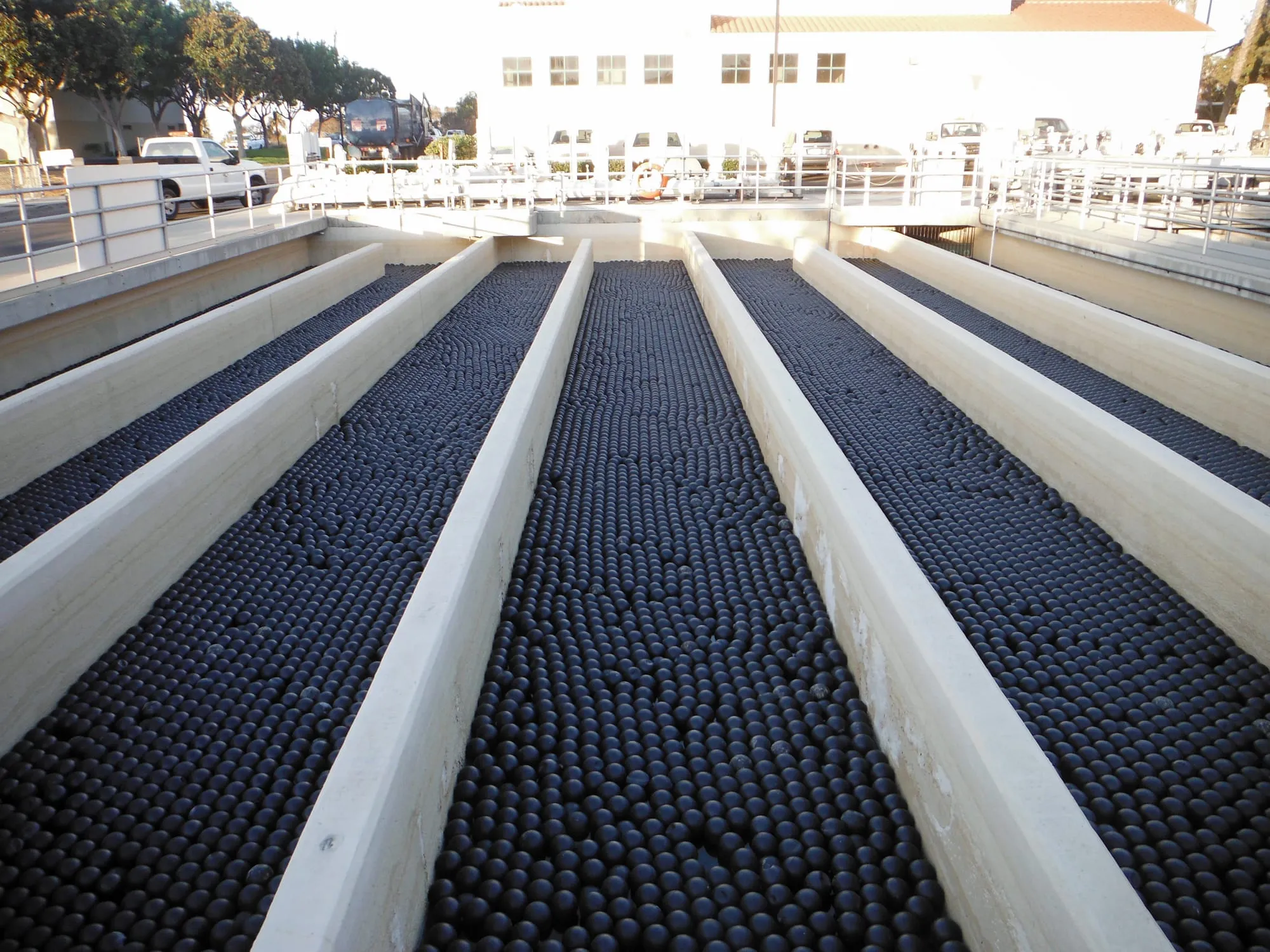
Armor Ball® pours onto any open liquid surface and self-arranges into a dense 91% interlocking cover — cutting evaporation up to 90%, blocking algae, suppressing odor, and insulating. Built thicker, heavier, and tougher for demanding industrial sites.
- 91%
- Coverage
- 35 MPH
- (75 AQUA)
- 25+ yr
- Design life
- 10-yr
- Warranty
Source: AWTT published data
Types of hollow plastic ball
"Hollow plastic ball" can mean two very different things. Small precision spheres are sold for valves and bearings; large floating-cover balls (shade balls) are floated on open water to cut evaporation, UV, and algae. This site covers the floating-cover kind — and its heaviest-duty form, Armor Ball®.
| Type | Typical size | What it's for |
|---|---|---|
| Precision / industrial spheres | ~3 mm – 2 in | Tiny molded balls used in check valves, bearings, roll-on bottles, and lab floats — sold by precision-ball suppliers, unrelated to surface covers. |
| Shade balls (floating cover) | ~100 mm (4 in) | Larger HDPE balls floated en masse to block sunlight on reservoirs — cutting UV-driven reactions, algae, and evaporation. The category this site covers. |
| Armor Ball® (heavy-duty cover) | 100 mm (4 in) | The industrial-grade floating-cover ball: thicker-walled UV-stabilized HDPE, 91% coverage, pH 2–13 resistance, R-2 insulation, 25+ year life. |
The problem
An open liquid surface is a compounding liability
Every uncovered pond, lagoon, or tank loses water, breeds algae, vents odor, attracts wildlife, and bleeds heat — at once.
Evaporation
An uncovered 5-acre pond can lose over 1,000,000 gallons of water a year — money and a scarce resource evaporating into the air.
Algae & cyanobacteria
Sunlight feeds algae and cyanobacteria blooms that foul water, clog equipment, and trigger costly treatment.
Odor & VOCs
Open surfaces release odor, H₂S, and VOCs — fueling nuisance complaints and regulatory pressure.
Birds & wildlife
Open water attracts waterfowl that contaminate it and, near airfields, create strike hazards.
Heat loss
Heated process water bleeds energy from its open surface, driving up heating costs.
Fragile covers
Thin shade balls and complex membrane covers can be short-lived, costly to install, or hard to maintain.
How it works
From bulk delivery to a 91% cover — no anchors, no draining
- 01
Calculate quantity
Use the surface area of your pond or tank to determine how many balls you need — about 10 balls per ft² (108/m²).
- 02
Deliver in bulk
Balls ship in bulk and unload quickly; no special equipment or site prep is required.
- 03
Pour onto the surface
Pour the balls directly onto the open liquid surface. No anchors, cables, liner penetration, or draining needed.
- 04
Self-arranges into 91% cover
The balls float and self-interlock into a dense 91% layer that self-adjusts as the liquid level changes.
The balls self-adjust as the liquid level changes, push aside for equipment access, and re-cover the surface automatically — with no maintenance. See the physics →
Benefits
One cover, eight industrial-grade benefits
Up to 90% less evaporation
A dense 91% floating layer chokes off the open water surface, cutting evaporative water loss up to 90% — water and dollars kept in the pond.
Algae & cyanobacteria control
Blocking sunlight at the surface starves photosynthesis, suppressing algae and cyanobacteria blooms without adding chemicals.
Odor & VOC suppression
The cover acts as a physical barrier that suppresses odor, H₂S, and VOC emissions rising off the liquid — easing nuisance and compliance pressure.
Bird & wildlife deterrent
A covered surface deters waterfowl and wildlife, reducing contamination and the cleanup and compliance costs that follow.
R-2 thermal insulation
The floating layer insulates the surface at R-2, cutting heat loss and reducing heating costs up to 70% in temperature-sensitive processes.
Extreme chemical & temperature resistance
UV-stabilized HDPE is inert to most industrial liquids across pH 2–13 and holds up from −70°F to +160°F.
Zero maintenance
Once poured, the cover self-adjusts to changing levels and needs no maintenance — no draining, no servicing.
Tool-free install
No anchors, cables, liners, or heavy equipment. Pour the balls onto the surface and they self-arrange into an interlocking cover.
Applications
Proven across demanding industries
From wastewater and reservoirs to mining, oil & gas, and airports — Armor Ball® works in any pond geometry.
Shade balls vs. Armor Ball®
The industrial-grade evolution of the shade ball
Basic shade balls block light. Armor Ball® is engineered to cover, conserve, resist, and insulate.
| Attribute | Commodity shade balls | Armor Ball® |
|---|---|---|
| Construction | Thin-walled | Thicker-walled / reinforced HDPE |
| Weight per ball | 29–40 g | 50 g |
| Plastic / material | Mixed recycled (post-industrial or post-consumer), unverified source — often contaminated, oxidized, and weaker | Pure HDPE — virgin blended with traced, tested recycled HDPE; no other plastics mixed in |
| Primary purpose | Block sunlight | Heavy-duty floating cover (evaporation, UV, odor, insulation) |
| Surface coverage | Varies | 91% |
| Buoyancy | Not typically rated | 10.9 lb/ft² (53 kg/m²) |
| Chemical resistance | Limited | Excellent; inert across pH 2–13 |
| Operating temperature | Not typically rated | −70°F to +160°F |
| Insulation | None rated | R-2 |
| Wind rating | Not typically rated | 35 MPH (75 MPH for AQUA) |
| Life expectancy | Often 3–10 years | 25+ years |
| Warranty | Varies / none | 10 years (manufacturer) |
Weight doesn't lie: a hollow ball is simple geometry, so less weight means less plastic and a thinner, weaker wall — Armor Ball's 50 g carries more material than 29–40 g commodity balls. Armor Ball® also uses pure HDPE with no other plastics mixed in, blending virgin resin with traced, tested recycled HDPE; per AWTT, it is the only floating-modular-cover maker that tests its recycled feedstock for contaminants. Armor Ball® is the lowest-cost, easiest-to-deploy ball cover for sheltered-to-moderately-exposed sites; AWTT's wider range spans 30 MPH to 130+ MPH wind and R-1 to R-17+ insulation. Full comparison →
ROI & savings
See what a cover could save you
Estimate annual water and dollar savings from cutting evaporation. Transparent formulas, instant results.
Evaporation & ROI calculator
Estimate your water savings
Armor Ball® delivers up to 90% reduction; default 88%.
Add project cost for payback (optional)
Estimated annual savings
Estimates based on typical field performance; actual results depend on local climate, wind, and site conditions. Request a detailed engineering assessment.
Track record
700+ installations across 25 countries — the most widely deployed product in AWTT's portfolio
Armor Ball® is manufactured in North America by Advanced Water Treatment Technologies Inc., which markets the first patented self-ballasted floating cover and a family of covers spanning 30 MPH to 130+ MPH wind and R-1 to R-17+ insulation.
Customer references available on request.
FAQ
Hollow plastic ball cover questions, answered
What is a hollow plastic ball cover?
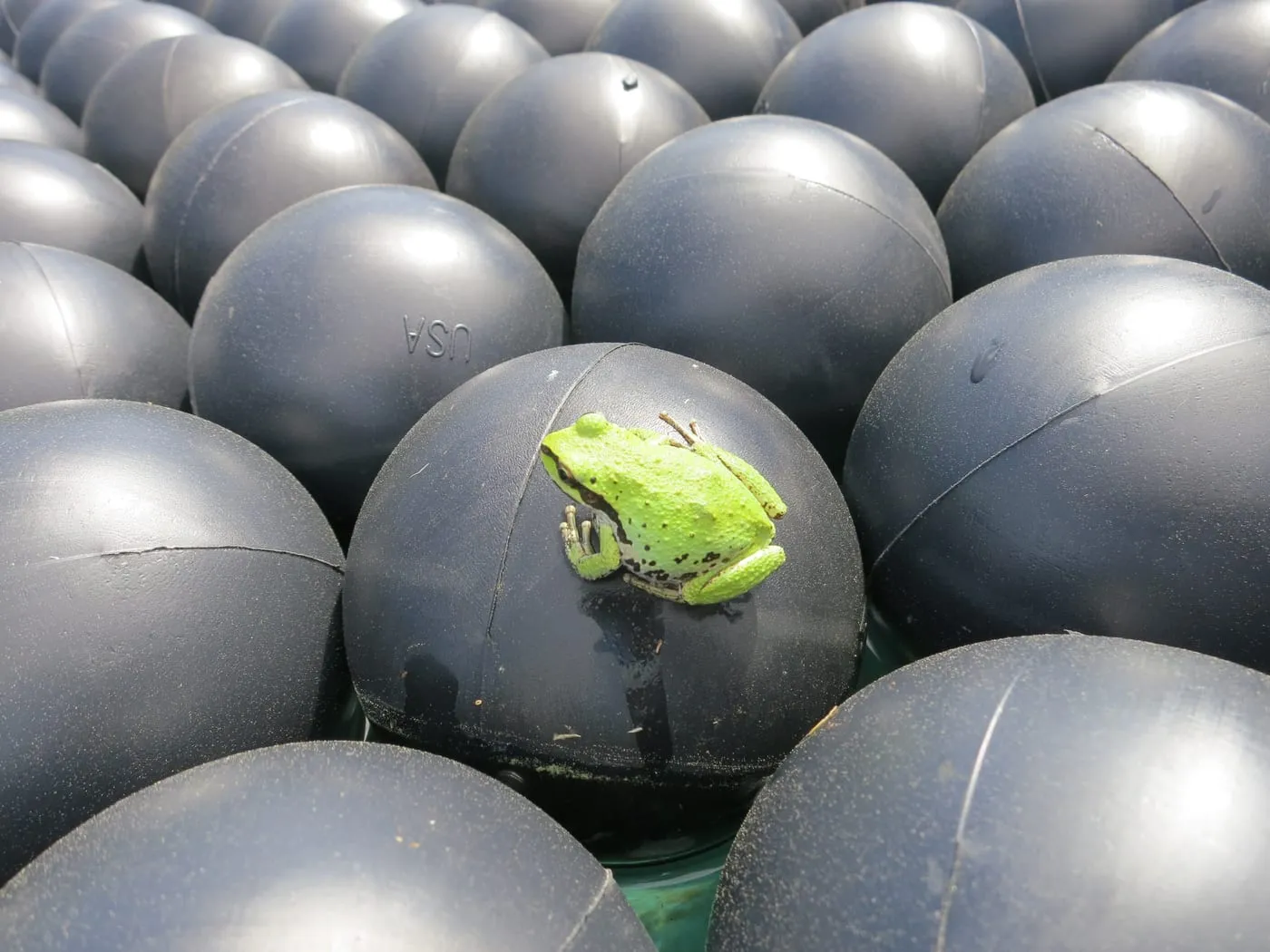
A hollow plastic ball cover is a floating cover made of many hollow plastic balls that are poured onto an open liquid surface, where they self-arrange into a dense interlocking layer. Armor Ball® is a heavy-duty version: a 100 mm (4 in) UV-stabilized HDPE ball that covers 91% of the surface to cut evaporation, block UV, suppress odor, and insulate.
How many balls do I need for my pond?
Armor Ball® covers at about 10 balls per square foot (108 per m²). Multiply your surface area by that density — for example, a 1-acre pond (43,560 ft²) needs roughly 435,600 balls. Use the coverage calculator for an exact figure.
How long does it take to install a ball cover?
Installation is tool-free: the balls are poured directly onto the liquid surface and self-arrange into a 91% interlocking layer. A 53-ft dry van of Armor Ball® AQUA unloads in about 1–2 hours, with no anchors, cables, draining, or liner penetration.
How do ball covers perform in wind?
Standard Armor Ball® is rated for 35 MPH (56 km/h) winds. For more exposed sites, Armor Ball® AQUA uses pre-filled, factory-sealed water ballast to reach 75 MPH (120 km/h). AWTT's wider cover range extends to 130+ MPH.
Will the balls affect my equipment or wildlife?
The free-floating balls push aside for equipment and intakes, then re-cover the surface automatically. They deter waterfowl and wildlife by removing the open water that attracts them, while letting rain and snow pass through.
How much maintenance does the cover need?
None. Once poured, the Armor Ball® layer self-adjusts to changing liquid levels and is not damaged by ice or snow, with a 25+ year design life and a 10-year manufacturer warranty.
What chemicals is Armor Ball® compatible with?
Armor Ball® is molded from UV-stabilized HDPE that is inert to most industrial liquids across pH 2–13 and rated from −70°F to +160°F. Request material certifications and SDS to confirm compatibility with your specific liquid.
How do ball covers compare to geomembrane floating covers?
Ball covers pour onto the surface with no anchors, cables, or liner penetration and self-adjust to level changes, whereas geomembrane covers are engineered, anchored installations. Ball covers also allow equipment access and rain/snow passage that a sealed membrane does not.
How is Armor Ball® different from commodity shade balls?
Armor Ball® is a thicker-walled, reinforced HDPE ball engineered for industrial duty: 91% coverage, 10.9 lb/ft² buoyancy, chemical resistance across pH 2–13, R-2 insulation, a −70°F to +160°F range, a 25+ year life, and a 10-year warranty — versus thin-wall commodity shade balls intended mainly to block light.
What are shade balls?
Shade balls are hollow plastic balls — typically HDPE — floated on the surface of a body of water so that, en masse, they block sunlight from reaching the water below. Poured onto a surface, they self-arrange into a dense floating layer that shades the water without anchoring or mechanical structure. Armor Ball® is the heavy-duty, industrial-grade shade ball.
Do shade balls work?
Yes. A dense shade-ball layer blocks the sunlight that drives algae growth and UV reactions such as bromate formation, and by removing most of the open water surface it cuts evaporation up to 90% per AWTT published data. Armor Ball® delivers this with 91% surface coverage and a 25+ year design life.
Is HDPE safe for potable water?
Armor Ball® is molded from UV-stabilized HDPE specified for potable-water/food-contact use when required, with material certs, SDS, and NSF/ANSI 61 documentation where applicable available on request.
Can the cover be installed without draining the pond?
Yes. Armor Ball® is poured directly onto the existing liquid surface, so there is no need to drain or take the basin offline to install it.
What warranty and lifespan does Armor Ball® have?
Armor Ball® carries a 25+ year design life and a 10-year manufacturer warranty per AWTT published data.
Do hollow plastic ball covers actually save water?
Yes. A dense floating ball cover removes most of the open water surface, which is where evaporation happens. Armor Ball® covers 91% of the surface and cuts evaporation by up to 90%, so an uncovered 5-acre pond losing over 1,000,000 gallons a year can save the large majority of that loss.
What are hollow plastic balls used for?
Large hollow plastic balls (about 100 mm / 4 in) are used as floating covers on open liquid surfaces — reservoirs, lagoons, tanks, and tailings or frac ponds — to cut evaporation, block UV (controlling algae and bromate formation), suppress odor and VOCs, deter birds, and insulate heated liquids. Small precision hollow balls are a separate product used in valves, bearings, and floats.
How much does a hollow plastic ball cover cost?
Cost depends on surface area, ball type (standard vs. water-ballasted AQUA), and freight, so Armor Ball® is quoted per project. Because the balls last 25+ years with no maintenance and reduce water, chemical, energy, and treatment costs, the lifecycle cost per covered square foot is typically far lower than the upfront price suggests. Request a quote with your surface area for an exact figure.
Get a custom Armor Ball® quote
Tell us about your site — surface area, liquid, and goals — and we'll size a cover and respond within 24 hours.
Manufactured by AWTT · 700+ installations · 25 countries · 10-year warranty